A Thoughtful Choice Books & Games
Ages 7–12: Thinking-Ahead Strategy Games
Ages 7–12: Thinking-Ahead Strategy Games
Free U.S. shipping
Couldn't load pickup availability
Games in this collection:
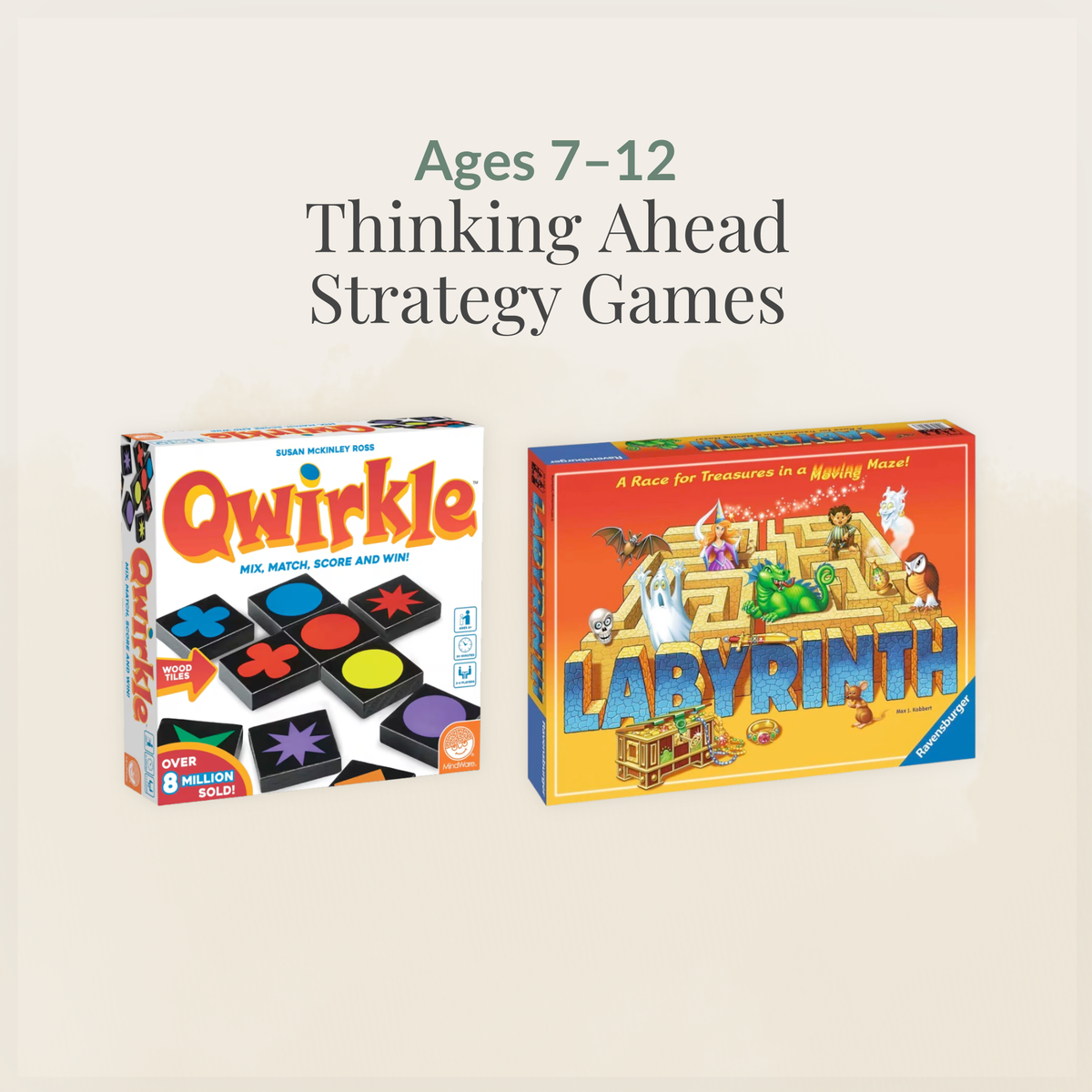
Qwirkle by MindWare (2011 Spiel des Jahres Winner; Mensa Select Award)
Players: 2–4 • Play time: ~30–60 minutes
Labyrinth by Ravensburger (1986 Spiel des Jahres Recommended)
Players: 2–4 • Play time: ~20–30 minutes
This collection helps children move from making a good move now to thinking about what that move might make possible next—recognizing patterns, planning future opportunities, and adapting when the board changes.
Who this collection is for:
This collection is designed for boys and girls ages 7–12 who understand basic game strategy and are ready to begin thinking beyond the immediate turn. It’s especially well suited to children who enjoy patterns, visual puzzles, routes, and games where several moves may be possible but choosing the right one takes thought.
If your child enjoys matching landscapes and making first strategic placement decisions in Dragomino by Blue Orange Games, this collection offers a natural next step—asking players to consider more possibilities, plan for future turns, and adjust when another player changes the opportunities available.
The two games approach thinking ahead in very different ways. Qwirkle asks players to recognize patterns and create opportunities for future scoring, while Labyrinth asks them to plan routes through a maze that changes on every turn.
What’s inside:
Qwirkle begins with a wonderfully simple rule: build lines of tiles that match by either color or shape, without repeating the same tile within a line.
That simplicity quickly opens into much richer decision-making. Players can often place a tile in several different locations, but those choices may produce very different results. A well-planned placement can score in more than one direction at once, extend a promising pattern, or set up an opportunity for a larger score on a later turn.
Players also have to think about what they are making possible for everyone else. Leaving a nearly complete line may create an opportunity for an opponent to score a six-tile Qwirkle, while holding or placing a particular tile differently may preserve a better opportunity for the future.
Because players draw new tiles throughout the game, plans cannot be rigid. They must continually reassess the board, recognize new patterns, and decide how best to use the pieces they have.
That makes Qwirkle an excellent introduction to an important strategy habit: look beyond the points available right now and consider what a move might create next.
Labyrinth develops that same habit through route planning. Players search for treasures hidden within a maze—but before moving their playing piece, they must slide a maze tile into the board, shifting an entire row or column of pathways.
That single change can open the route they need, close one they were counting on, or completely alter another player’s options. Children must visualize what the maze will look like after the shift and decide which change gives them the strongest path toward their goal.
And because every other player changes the maze too, even a carefully planned route may disappear before the next turn. Players learn that thinking ahead isn’t only about making a plan—it’s also about recognizing when circumstances have changed and finding a new one.
Together, these games develop two complementary forms of forward thinking: Qwirkle teaches players to recognize and create future opportunities, while Labyrinth teaches them to plan routes and adapt as possibilities continually change.
Why this collection works:
- Develops thinking ahead and multi-step planning
- Strengthens pattern recognition
- Encourages players to create future opportunities
- Builds route planning and visualization
- Develops flexible thinking when circumstances change
- Encourages players to consider how their moves affect opponents
- Strengthens decision-making and logical reasoning
- Offers simple rules with strategy that deepens with experience
- Remains engaging across a broad age range
These games help children make an important strategic shift: instead of asking only “What is my best move right now?”, they begin asking “What will this move make possible next?”
Why A Thoughtful Choice picked these:
We chose these games because they teach children to think ahead without requiring complicated rules.
Qwirkle starts with familiar matching but gradually rewards players who see several possibilities at once, create future scoring opportunities, and pay attention to how the growing pattern affects everyone at the table. Labyrinth makes forward planning more visual, challenging children to imagine how one change to the maze will reshape the routes available afterward.
Both games also teach an equally important strategy skill: adaptability. A promising Qwirkle opportunity may change when another player places a tile. A perfect route through Labyrinth may disappear when someone shifts the maze. Players learn to notice what has changed and make a new plan rather than simply continuing with the old one.
Together, they create a natural bridge between first tactical games and the next stage of strategy, where players begin thinking more intentionally about territory, position, blocking, and optimization.
What to play next:
Children ready to use their thinking-ahead skills in more competitive spatial play can progress to Ages 8–12: Spatial Strategy Games, where Kingdomino and Battle Sheep introduce territory, drafting, blocking, and spatial optimization.
Players ready to add resource gathering and competing priorities to their strategic thinking can explore Ages 9+: Creature Comforts — Resource Planning Game, a welcoming introduction to resource management and planning across several goals.
Share